Recover The Heat Your Dryers Throw Away
Drying, steam and CHP engineering for mills where heat is the product cost. We audit, design and verify the measures that cut energy per tonne without touching sheet quality.
What Makes This Sector Different
Four verified numbers that frame every energy conversation in this sector.
The Pressures Squeezing Every Mill
Six problems we hear from mill engineering managers, energy managers and operations directors.
Dryer hoods heating the sky
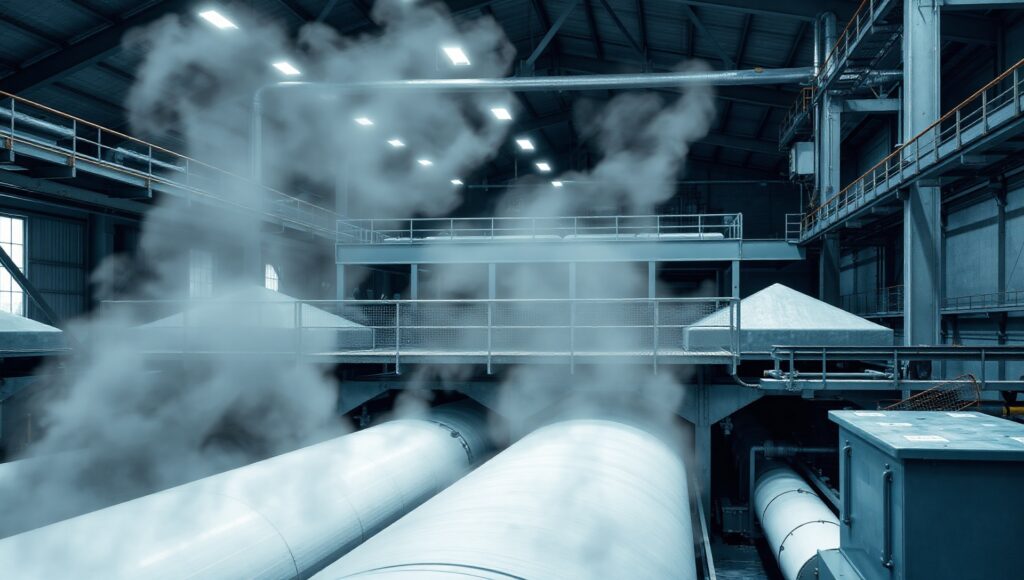
Warm, humid exhaust leaves the hood around the clock, and most of its heat goes straight to atmosphere. It is typically the largest recoverable energy stream in the building, yet it rarely has a project owner or a budget line.
Steam systems degraded over decades
Trap populations nobody has surveyed in years, bare pipework and valves, condensate dumped to drain and flash steam vented. Each loss looks small on its own. Added up across the distribution system, they quietly inflate every tonne you make.
CHP dispatch built for yesterday's prices
The turbine was sized and the dispatch logic written for a fuel and power market that no longer exists. The spark spread has moved through several cycles since commissioning, and what was once obviously profitable running may now be marginal.
Moisture control trading off against energy
Machine crews run the dryers hot and safe because a moisture excursion costs more than steam does. Without hood balance data and pocket ventilation control, the energy bill silently pays for that insurance every shift.
Fibre and energy costs squeezing margin together
Both of your largest input costs have risen at once, and you control neither price. Energy per tonne is the variable you can actually engineer, which makes specific energy consumption the most useful number in the monthly review.
Biomass strategy unclear
Bark, residues, gas and grid power all compete in the fuel mix, and carbon prices keep moving the answer. Without a current techno-economic model, boiler and fuel decisions stall, and so does the decarbonisation roadmap behind them.
What We Engineer In Your Plant
The sub-systems that set a mill's energy per tonne, and what we do with each of them.
Drying sections and hood heat recovery
We measure the hood balance, raise exhaust dew point towards 60 to 65 degrees C and design multi-stage recovery to supply air, white water and fresh water.
Press section dewatering
We assess shoe press performance, felt condition and nip management, because each percentage point of post-press dryness typically cuts dryer steam demand by roughly 4%.
Steam and condensate systems
We survey traps, thermocompressors and cascade condensate loops, then specify the repairs, insulation and flash steam recovery that stop the losses.
CHP and biomass boiler optimisation
We model turbine dispatch against current spark spreads and fuel mix so the plant runs for today's prices, not the ones it was commissioned for.
Vacuum systems
We drop unneeded vacuum levels, add variable speed drives and evaluate liquid ring to turbo blower conversions, measures that commonly save 20 to 50% of vacuum power.
Refining loads
We benchmark refiner specific energy, where TMP lines typically draw 2 to 3 MWh per tonne, and verify that refiner heat recovery to process steam is actually delivering.
Compressed air
We fix leaks, lower pressure setpoints and right-size compressors, with 10 to 30% savings on the affected systems being a credible audited range.
Heat upgrading with MVR and heat pumps
We evaluate mechanical vapour recompression and high temperature heat pumps for lifting hood exhaust and effluent heat back to low pressure steam.
How The Work Gets Done
Every engagement follows the same engineering discipline, whatever the sector.
Discover
Audits, assessments and baseline development that establish what actually drives your energy cost and carbon.
Design
Feasibility, concept design, modelling and the business case that turns an opportunity into a fundable project.
Deliver
Tendering, procurement, engineering design, delivery and commissioning, around production rather than in spite of it.
Manage
Continuous improvement and verified performance, so the gains are still there years later.
Proof From The Machine Floor
Anonymised, verified results from drying, steam and heat recovery work in mills and panel plants.
Frequently Asked Questions
How much heat can a dryer hood recovery system capture?
On a large modern paper or board machine, the exhaust can carry more than 50 MW of recoverable heat, equivalent to roughly 86 tonnes of steam per hour. What you actually capture depends on the sinks available: supply air, white water, fresh water and ventilation. Documented rebuilds have delivered around 14% site energy savings with payback inside one to two heating seasons. A hood balance and dew point survey tells you your machine's number before any capital is committed.
Does heat recovery affect sheet moisture control?
Not when it is engineered properly. Recovery sits on the exhaust side of the hood, downstream of the sheet. The work that raises recovery potential, balancing supply and exhaust air, controlling pocket ventilation and lifting exhaust dew point towards 60 to 65 degrees C, is the same work that stabilises the drying environment. We design around the machine's moisture profile and verify it before and after commissioning.
When does CHP still make sense?
Around half of the electricity consumed by the European pulp and paper sector is already produced on site through cogeneration, so the question is rarely whether to have CHP but how to run it. The economics swing with the spark spread, the gap between power price and fuel cost. We model dispatch against current fuel, power and carbon prices, and revisit it through each price cycle rather than leaving the plant on commissioning-era logic.
Stop Paying To Heat The Sky
A mill-wide thermal audit tells you, in tonnes of steam and euros per tonne, what your dryer exhaust, steam losses and CHP dispatch are really costing. The first conversation costs nothing.


